I spent thirty-four years listening to the relentless, high-pitched whine of industrial mixers at four in the morning, and if there is one thing I’ve learned, it’s that the machine is often just a way to avoid actually feeling your bread. People will try to sell you expensive stand mixers or complicated gadgets, claiming they are the only way to get a decent crumb, but they are lying to you. Most of those fancy machines actually strip the life out of the dough because they do all the work without any of the intuition. If you are wondering how to bake without a mixer, you aren’t looking for a shortcut; you are looking to reconnect with the flour and the water.
I’m not going to give you a list of “hacks” or tell you to use a whisk like it’s some magical wand. Instead, I’m going to teach you how to use your hands to read the tension and the temperature of the dough, because that is where the magic happens. We will talk about the rhythm of the fold and the strength of the stretch, focusing on the way the dough responds to your touch rather than how fast a motor can spin. I promise you, once you learn the language of the dough, you’ll realize you never actually needed that machine to begin with.
Mastering Manual Dough Mixing Methods With Intention
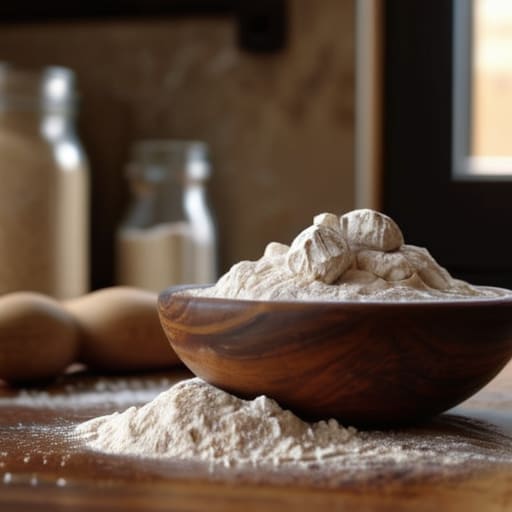
Now, if you’re going to set aside the machine, you have to stop thinking of mixing as a chore and start seeing it as a conversation. When you use a stand mixer, you’re essentially bullying the flour into submission; it’s efficient, certainly, but it’s blind. Using manual dough mixing methods allows you to actually feel the moment the flour hydrates and the tension begins to build. I always reach for a heavy wooden spoon first. There is something about the weight of a sturdy piece of wood that helps you move through a thick, shaggy mass without tiring your wrists as quickly as a metal spoon would.
As you work, don’t just stir blindly. You’re looking for the transition from a gritty, broken mess to something cohesive. If you’re working a high-hydration dough—say, something in the 75% to 80% range—you might find that developing gluten without machines is less about vigorous stirring and more about the gentle art of the fold. You aren’t fighting the dough; you are guiding it. If it feels tight and stubborn, give it ten minutes to rest. The dough needs time to catch up to your efforts, and patience is much kinder to your joints than force ever will be.
The Truth About Developing Gluten Without Machines
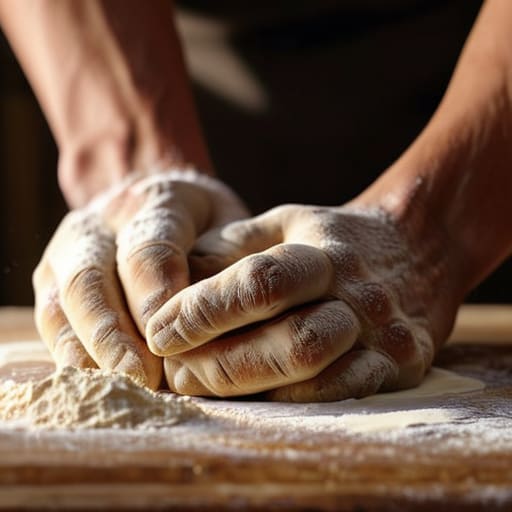
Most people think gluten development is a mechanical process—that you need a heavy-duty motor to whip those proteins into submission. They’re wrong. Gluten isn’t something you “beat” into existence; it’s something you encourage. When you’re using alternatives to electric stand mixers, you aren’t just moving ingredients around; you are feeling the structural change through your fingertips. In the bakery, I never relied on a machine to tell me if a dough was ready. I relied on the way it transitioned from a shaggy, tearing mass into something that felt silky and elastic.
If you are worried about the lack of a hook, remember that developing gluten without machines is mostly a matter of patience and physics. Techniques like the slap and fold or even simple rhythmic folding during a long autolyse do more work than a high-speed blade ever could. A machine can actually be too aggressive, shearing the dough before it has a chance to relax and strengthen. When you work by hand, you aren’t just building strength; you are learning the exact moment the dough has had enough.
Five Little Secrets for the Hand-Baker
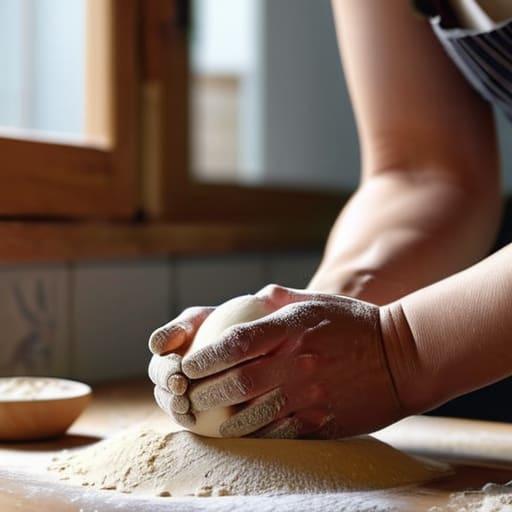
- Listen to the dough, not your ego. When you’re mixing by hand, you’ll feel that moment where the shaggy, tearing mass suddenly turns silky and cohesive. Don’t keep pushing just because the clock says you should; once that tension is there, stop. Overworking a dough with your hands is much easier than doing it with a machine, and once you’ve lost that structure, you can’t get it back.
- Temperature is your silent partner. Since you aren’t using a high-speed motor to generate friction heat, your dough might stay cooler than a machine-mixed batch. If your kitchen is drafty, use water that’s a few degrees warmer than you think you need. I always aim for a final dough temperature of about 26% higher than my ambient room temp to keep things moving.
- Use the “Autolyse” to do the heavy lifting. If you want to save your wrists, mix just your flour and water first and let it sit for thirty minutes to an hour before you even touch the salt. This lets the flour hydrate and the enzymes start building gluten on their own. By the time you actually start mixing, the dough will feel like it’s halfway there already.
- Don’t be afraid of the “Slap and Fold.” If you’re working with a higher hydration dough—say, something in the 75% to 80% range—don’t try to knead it like a traditional bagel dough. Pick it up, slap it onto the counter, and fold it over itself. It builds strength without you having to fight the stickiness.
- Respect the rest. In a bakery, we don’t rush the bulk fermentation. If you’re mixing by hand, you’re already taking a more intimate, slower approach. Give the dough frequent, gentle folds every thirty minutes rather than one long, aggressive kneading session. It keeps the air bubbles intact and builds a much better crumb.
Lessons from the Bench
Trust your skin, not your eyes; a dough’s readiness is felt in the tension against your palm and the way it resists or yields, not by how it looks in a staged photo.
Temperature is your invisible ingredient, so if your kitchen is drafty, don’t blame the lack of a motor—just give the dough a little more time and a warmer corner to wake up in.
Stop fighting the flour; manual mixing is about rhythm and patience, working with the dough’s natural strength rather than trying to force it into submission with speed.
The Rhythm of the Kitchen
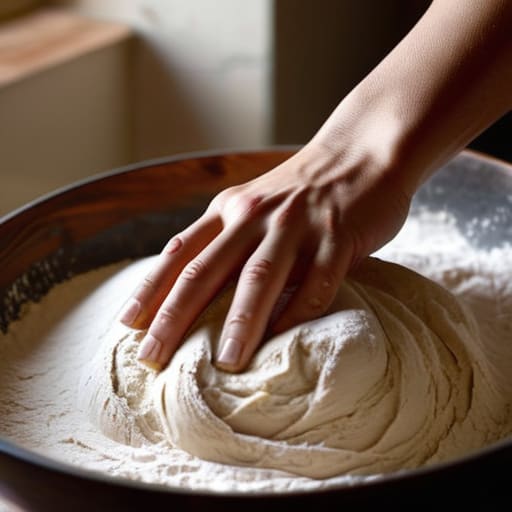
At the end of the day, baking without a machine isn’t about making things difficult; it’s about removing the barrier between your skin and the flour. We’ve talked about why you don’t need a motor to build a strong gluten network, how a bit of extra time and a few sets of folds can do more for your structure than any high-speed attachment ever could, and why temperature and patience matter more than any gadget in your cupboard. If your dough feels tight or stubborn, don’t reach for the plug in the wall. Instead, check the warmth of your water, look at the clock, and remember that strength comes from tension and time, not from electricity.
I spent thirty-four years listening to the sounds of a busy bakery, and I can tell you that the most rewarding loaves are the ones you truly felt into being. There is a certain kind of magic that happens when you stop fighting the dough and start listening to it. When you stop treating bread like a mechanical process to be conquered and start treating it like a living thing to be nurtured, you’ll find that the results are far more soulful than anything a machine could produce. So, put the mixer away, clear your counter, and trust your hands—they know more than the manual ever will.
Frequently Asked Questions
If I'm not using a machine to do the heavy lifting, how do I know when the gluten is actually developed enough to stop working?
You stop when the dough stops fighting you. If you’re pulling at it and it snaps back like a rubber band, it’s not ready. You’re looking for that windowpane—stretch a small piece of dough between your fingers until it’s thin enough to see light through without it tearing. It should feel supple and alive, not tight and angry. If it’s smooth and holds its shape, your hands have done their job.
Will my dough still rise properly if I'm mixing by hand, or am I going to lose all that air that a mixer usually incorporates?
Oh, darling, don’t you worry about that. A machine doesn’t “add” air; it just forces it in through sheer violence. When you mix by hand, you aren’t losing air; you’re being more careful with the structure you’re building. If your dough doesn’t rise, it isn’t because you lacked a whisk—it’s because your kitchen was too chilly or you didn’t let the yeast have its time. Trust your hands, not a motor.
My arms are already tired just thinking about this—is there a way to mix without it becoming a full-body workout?
Oh, darling, I hear you. My shoulders certainly gave out long before my spirit did. If you try to fight the dough, you’ll lose every time. The trick isn’t strength; it’s leverage and patience. Use the “slap and fold” method on a wet surface to let gravity do the heavy lifting, or simply let a long autolyse—just flour and water sitting for an hour—soften the gluten for you. Let the chemistry work so your muscles don’t have to.