I remember a Tuesday in mid-November, thirty years ago, when I tried to double a batch of brioche for a local wedding using nothing but a set of measuring cups and a prayer. I ended up with a heavy, greasy mess that sat in the bottom of the tin like a wet brick, and I spent the next three hours scrubbing flour off my ceiling while questioning my entire life’s work. Most people will tell you that scaling a recipe is just simple multiplication, but they are lying to you; if you don’t understand the underlying math, you aren’t actually following a complete guide to scaling recipes, you’re just playing a dangerous game of chance with your ingredients.
I am not here to sell you a fancy calculator or a subscription to a math app. What I am going to give you is the honest, unvarnished truth about how dough behaves when you change its volume. We are going to move away from the deception of cups and dive straight into the discipline of baker’s percentages, so you can grow your production without losing the soul of the loaf. I’ll show you how to maintain your hydration and salt ratios every single time, because once you master the math, you finally stop guessing and start baking.
Mastering Bakers Percentages for Scaling Without Error
If you want to stop treating your kitchen like a guessing game, you have to stop thinking in totals and start thinking in ratios. I don’t care if you’re making one boule for your Sunday toast or twenty loaves for a village fete; the relationship between the flour and the water must remain sacred. This is where baker’s percentages for scaling become your best friend. We treat the flour as 100%, and every other ingredient—the salt, the yeast, the water—is simply a fraction of that weight. When you master this, you aren’t just following a list; you are understanding the very DNA of your dough.
The beauty of this method is that it makes scaling recipe ratios accurately an effortless bit of arithmetic rather than a frantic search for a bigger measuring cup. If you decide to increase your flour from 500g to 2kg, you don’t have to wonder if you’ve added enough salt; you simply apply your percentage to the new total. It removes the guesswork that leads to heavy, salt-starved, or gummy bread. Once you stop converting volume to weight and start working with these fixed proportions, the dough stops being a mystery and starts behaving like a partner.
Converting Volume to Weight to Stop the Lies
If you are still reaching for a measuring cup, you are essentially gambling with your flour. I spent my first few years in the bakery thinking a cup of flour was a constant, until I realized that a packed cup from a humid Tuesday is a different beast entirely than a sifted cup on a dry Friday. This is why converting volume to weight isn’t just a suggestion; it is the only way to ensure your dough behaves the same way every time you walk into the kitchen. When you measure by weight, you are finally speaking the same language as the grain itself.
When you start scaling recipe ratios accurately, you’ll find that the math remains steady even when the volume explodes. If you try to triple a recipe by counting out scoops, you will inevitably end up with a dough that is either a sticky, unmanageable mess or a tight, lifeless brick. By using a scale, you aren’t just measuring ingredients; you are maintaining the integrity of the hydration. Whether you are making one loaf for your breakfast table or ten for a village market, the weight tells the truth that the cup is too clumsy to whisper.
Five Truths for When the Batch Gets Bigger
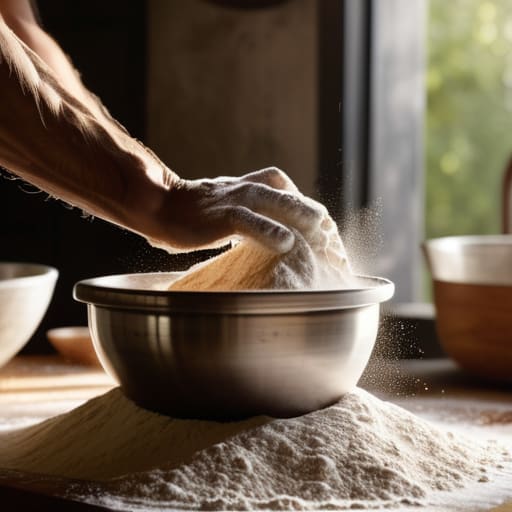
- Respect the Hydration Constant. When you scale a recipe up, don’t just multiply everything and hope for the best. A dough at 75% hydration behaves differently in a five-kilogram mass than it does in a five-hundred-gram boule. As your volume grows, your friction from mixing increases, which warms the dough faster. Watch your water temperature; you might need to go slightly cooler to compensate for the extra work the machine—or your arms—are doing.
- The Salt Trap. People often think salt is just a seasoning, but it’s a regulator. When scaling up, even a tiny error in your salt percentage is magnified across the whole batch. If you’re off by even 0.5% in a small loaf, no one notices; if you’re off by that much in a commercial batch, you’ve ruined the fermentation and the flavor. Always weigh your salt separately; never eyeball it.
- Don’t Forget the Yeast’s Ego. Yeast is a living thing, not a mathematical constant. If you are scaling a recipe from a single loaf to a massive batch that will sit on a bench for twenty minutes while you shape it, you cannot simply multiply the yeast linearly. A massive mountain of dough generates its own heat and ferments much faster than a tiny bit of dough. If you scale the yeast exactly, you’ll find yourself racing against a dough that’s over-proofing before you’ve even finished your first shaping.
- Account for the Loss. In my shop, we called it “bowl tax.” When you scale up, you lose more dough to the sides of the mixer, the bench, and your own hands. If you need exactly ten loaves, don’t calculate for ten; calculate for eleven. It is much better to have a little scrap of dough left over for a snack than to realize your last loaf is twenty grams short because you didn’t account for the reality of the workspace.
- Temperature is Your Real Scale. You can have the most perfect math in the world, but if you scale a recipe and forget that a larger mass of dough holds heat longer than a small one, your timing will be a disaster. A large batch has more thermal inertia. It stays warm. It stays active. You must adjust your water temperature based on the total weight you are mixing, or you will lose control of the clock.
The Baker’s Essentials for Scaling Success
Forget the measuring cup; if you aren’t using a scale to track your weights, you aren’t scaling, you’re just guessing, and guessing is how you end up with a heavy, lifeless loaf.
Always calculate your baker’s percentages first to ensure the hydration and salt levels remain identical, no matter how many loaves you decide to throw in the oven.
Remember that scaling the ingredients doesn’t mean scaling the clock; a massive batch of dough generates its own heat and moves at a different pace than a single boule, so watch the dough, not the timer.
The Discipline of the Scale
At the end of the day, scaling a recipe is not about memorizing long strings of numbers or performing mental gymnastics every time you want to bake a larger batch. It is about understanding the relationship between your ingredients. Once you have abandoned the inaccuracy of the measuring cup and embraced the mathematical truth of baker’s percentages, you stop being a person who follows instructions and start being a baker who understands structure. Whether you are doubling a sourdough boule or halving a batch of brioche, the ratios remain your North Star. If you keep your hydration consistent and your weights precise, the dough will behave predictably, regardless of how much flour you throw on the bench.
Don’t let the math intimidate you; it is simply a tool to give you freedom. The goal isn’t to become a mathematician, but to reach a point where you can look at a bowl of dough and know exactly what it needs because you understand its soul. There will be days when the kitchen is too cold or your hands are too heavy, and even with perfect scaling, things might go sideways. When they do, don’t blame the math. Instead, lean into the process, trust your senses, and remember that patience is the only ingredient you cannot buy in a shop. Now, put the calculator away and go touch your dough.
Frequently Asked Questions
If I use baker's percentages to scale up a recipe for a large crowd, will I still need to adjust my fermentation times or the temperature of my water?
Percentages scale the ingredients, but they don’t scale the physics of your kitchen. If you’re moving from a single loaf to a massive batch, that dough mass will hold heat much longer than a small boule, likely speeding up your fermentation. You must watch the dough, not the clock. And if your water is too cold, a large mass will struggle to wake up; keep your temperatures precise, or you’ll be waiting all day.
When I'm scaling a dough down to a tiny single loaf, how do I handle the salt and yeast if the math gives me a weight that's too small for my scale to read accurately?
Listen, I’ve been there—staring at a scale that won’t budge while the math says you need 1.2 grams of salt. When you’re scaling down to a single loaf, don’t fight your equipment. If your scale bottoms out, scale the recipe up to a two-loaf batch instead. It’s better to have a little extra dough for a focaccia than to guess the yeast and end up with a brick. Precision isn’t just math; it’s knowing your tools.
Does the rule of percentages change if I'm moving from a bread dough to something more delicate, like a high-fat pastry or a cake batter?
The math stays the same, but the stakes get higher. Whether it’s a sourdough or a brioche, the percentages are your North Star. However, with a delicate cake or a high-fat pastry, your margin for error vanishes. In bread, a little extra flour won’t kill you; in a financier, a few grams too much can turn your masterpiece into a brick. The rule doesn’t change, but your precision must.